

Parents scroll fast. Students click even faster. And your school only has a few seconds to make a great impression online.
Whether it’s a heartwarming story about a second-grade art project, a championship game recap, or a last-minute schedule change, your digital content serves as the voice of your school. The challenge? Most school leaders are already juggling meetings, supervision duties, staffing concerns, parent questions, and about a hundred other responsibilities.
When exactly are you supposed to become a full-time writer?
That’s where AI comes in.
Think of AI as your communications assistant. It helps organize ideas, draft content, suggest headlines, and turn a handful of notes into something worth publishing. Used correctly, AI can help school administrators communicate more consistently without sacrificing quality or authenticity.
The key phrase is “used correctly.”
While AI can help you write, it still takes a human to make content meaningful. But, let’s learn how to use AI to improve parent engagement.
What Can AI Do for Your School? (Spoiler: Quite a Bit)
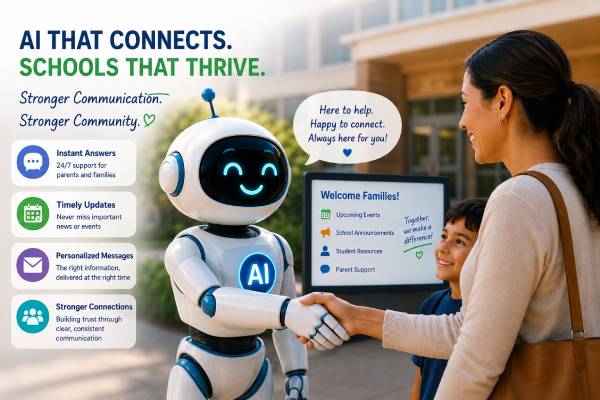
If you’re wondering what AI can actually help with, the answer is simple: almost any communication task that starts with a blank page.
AI can help create:
- Social media posts about school events, student achievements, and important reminders
- Website articles highlighting programs, activities, and accomplishments
- Principal newsletters and weekly updates
- Parent communications and email drafts
- Event announcements and recaps
- Staff spotlights and student success stories
- Photo captions and gallery descriptions
- Interview summaries and testimonial highlights
- Frequently asked questions and enrollment information
In other words, AI handles the heavy lifting of drafting so you can focus on what matters most: connecting with your community.
Why It Matters: The Engagement Trifecta
Strong school content serves three important audiences: current families, prospective families, and the students and staff who make your school special.
1. Parents
Good communication reduces confusion, builds trust, and helps parents feel connected to what’s happening at school.
When communication is consistent, parents:
- Feel informed and included
- Trust school leadership more
- Participate more actively in school activities
- Spend less time searching for information
As a bonus, your front office may receive fewer frantic calls that begin with, “Wait… today was early release?”
2. Prospective Families
Families researching schools often form opinions long before they ever schedule a visit. Your website and social media tell a story about who you are as a school. Consistent content helps prospective families:
- See your culture in action
- Understand what makes your school unique
- Picture themselves as part of your community
- Feel more confident about enrollment decisions
3. Students and Staff
Everyone likes to be recognized.
When schools regularly celebrate accomplishments, spotlight achievements, and share positive stories, students and staff feel valued.
Great content helps people:
- Feel appreciated
- Take pride in their work
- Build stronger connections to the school community
- See that their efforts matter
How to Use AI for School Content Creation
Ready to put AI to work? Here’s a simple process that works for almost any school.
Step 1: Choose Your AI Tool
The good news is that you don’t need to be a technology expert.
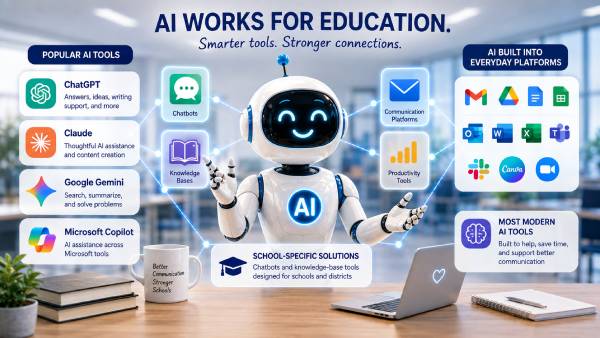
Popular AI tools include:
- ChatGPT
- Claude
- Google Gemini
- Microsoft Copilot
- School-specific chatbot and knowledge-base solutions
- AI features built directly into many communication and productivity platforms
Most modern AI tools can handle school communication tasks effectively. The best choice is often the one your team feels comfortable using consistently.
Step 2: Give It Better Instructions
AI is only as good as the information you provide.
The more specific your prompt, the better your results.
Instead of:
“Write a post about our assembly.”
Try:
“Write a friendly Facebook post about our Veterans Day assembly attended by 300 students. Include appreciation for local veterans, mention the student choir performance, and keep the tone warm and community-focused.”
The difference in quality can be dramatic.
Some useful prompts might include:
- “Write a website article about our school’s science fair using an enthusiastic but professional tone.”
- “Create three Facebook post options celebrating our teacher of the month.”
- “Summarize this event in two short paragraphs for a parent newsletter.”
- “Rewrite this announcement so it sounds friendlier and more conversational.”
The more context you provide, the more useful the draft becomes.
Download our FREE eBook: How Successful Schools Market Themselves.
Step 3: Add the Human Touch
This is where great school communications separate themselves from the crowd.
AI can generate content quickly, but it often lacks the little details that make a school feel real. It doesn’t know that Mrs. Johnson’s kindergarten class erupted into cheers when the butterfly emerged from its chrysalis. It doesn’t know that the marching band played through a surprise rain shower or that the football team carried their coach off the field after his 100th win.
Those details come from people.
Before you publish any AI-generated content:
- Add names, quotes, and observations from real people.
- Include specific moments that happened during the event.
- Mention local traditions and school culture.
- Highlight what students, parents, and staff actually said and did.
- Replace generic praise with meaningful examples.
Instead of writing:
Students enjoyed the event and learned valuable lessons.
Try:
Students crowded around the robotics display long after the competition ended, eager to show their parents how they programmed their machines to navigate the obstacle course.
Specific details create trust because they prove that someone was actually there.
Think of AI as your first-draft assistant. You’re still the storyteller.
Avoiding the “Robot Voice”
One of the biggest mistakes schools make with AI is publishing content exactly as it comes out of the tool.
Parents can often sense when content feels generic, even if they can’t explain why. That’s because AI tends to repeat certain writing habits.
Common AI giveaways include:
- Overusing buzzwords like transformative, innovative, and game-changing.
- Writing in vague generalities instead of sharing specific examples.
- Repeating the same sentence patterns throughout an article.
- Using dramatic punctuation and formatting too frequently.
- Making every event sound equally exciting and important.
The solution is simple: edit before publishing.
Read the content out loud. If it sounds like a marketing brochure, revise it. If it sounds like something you’d actually say to a parent standing in the school hallway, you’re probably on the right track.
The best school content feels personal, genuine, and connected to the community it serves.
Better Prompts Create Better Content
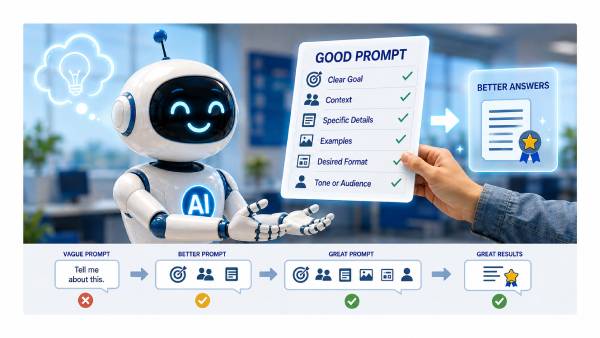
If you’ve ever thought, “AI doesn’t write very well,” the problem is often the prompt.
The more information you provide, the better the results.
Instead of:
Write a post about our science fair.
Try:
Write a 400-word website article about our science fair attended by 250 students and families. Focus on student creativity, parent involvement, and community support. Use a warm, conversational tone and include enthusiasm without sounding promotional.
Or instead of:
Write a principal message.
Try:
Draft a principal’s newsletter message using the notes below. Write as if the principal is speaking directly to parents. Keep the tone friendly, personal, and encouraging.
Small changes in your instructions can dramatically improve the quality of the content AI produces.
Some Prompts Schools Can Use to Make AI Sound More Human
Example #1: Newsletter Article
Instead of:
Write a newsletter article about our Veterans Day Assembly.
Try:
Write a 500-word newsletter article about our Veterans Day Assembly in the style of a small-town newspaper feature story. Use natural paragraph lengths, vary sentence structure, avoid marketing language, and include warmth and community spirit. Do not use em dashes. Make it sound like it was written by a school communications director who attended the event.
Example #2: School Website Story
Write a website article about our science fair. Focus on the students’ enthusiasm, the creative projects, and parent involvement. Use specific examples and observations. Avoid generic praise and marketing buzzwords. Write in a friendly, conversational style that sounds human and authentic.
Example #3: Principal Message
Draft a principal’s message using these notes. Write as if the principal is speaking directly to parents. Keep the tone warm and personal. Include a few reflective comments and observations. Avoid sounding corporate or promotional.
Example #4: Social Media Post
Write a Facebook post celebrating our Teacher of the Month. Make it sound like a real person wrote it. Avoid clichés and exaggerated praise. Include a specific detail about what makes this teacher special.
Final Thought: The Goal Isn’t to Sound Like AI
Schools don’t need more content. They need better content.
The most effective school communications combine the efficiency of AI with the authenticity of real people. AI can help organize ideas, draft messages, and save valuable time. But trust, relationships, and community connections still come from human voices.
The goal isn’t to sound more like AI.
It’s to use AI to sound even more like your school.
Let School Webmasters Be Your Easy Button
If you’re ready to take your content game to the next level, we can help.
At School Webmasters, we use AI tools and real storytelling to craft authentic, engaging school content for your website and social media channels. You lead, and we’ll help you handle the rest (including website content and social media posts). Contact Jim at 888-750-4556 or request a quote today!
To find Podcast parts 2 & 3, visit our podcast library.